
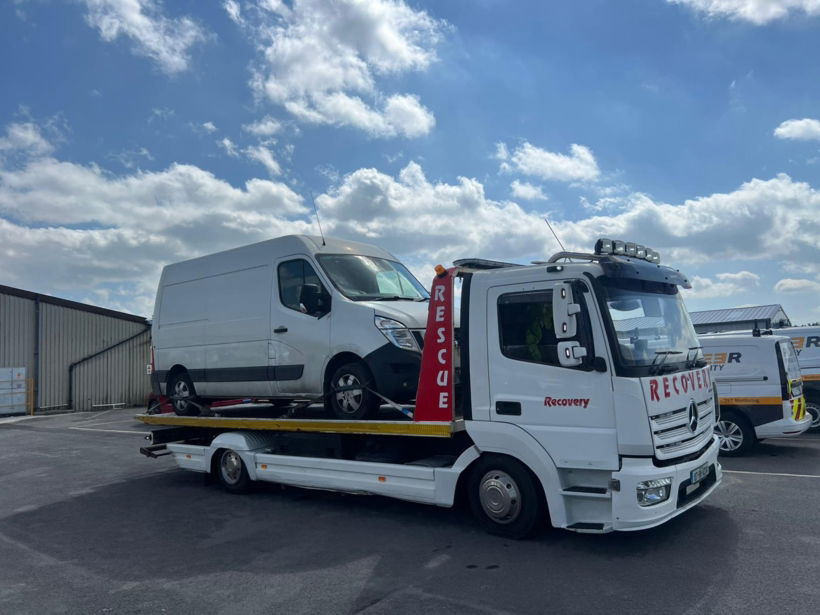
A breakdown in Dublin can go from inconvenient to dangerous very quickly. One moment you are driving through a busy junction, joining the M50, or edging along a narrow city street; the next, the engine cuts out, a warning light appears, a tyre fails, or the car will not move. In that moment, the priority is not diagnosing the fault. The priority is keeping yourself, your passengers and other road users safe while you arrange fast, suitable breakdown recovery.
This guide explains what to do if your car breaks down in Dublin, what information to give a recovery operator, when to call emergency services, and how your approach should change depending on whether you are on a city street, a dual carriageway or a high-speed route such as the M50. Keep it bookmarked on your phone, because the best time to understand breakdown recovery is before you are stuck at the roadside.
First priority: make the situation safe
If your car begins to lose power, steer smoothly and avoid sudden braking where possible. Turn on your hazard lights immediately so drivers behind you get an early warning. If you can still move, aim for the safest available stopping point: a parking bay, side road, lay-by, hard shoulder, wide verge or service area. Do not continue driving a badly damaged car just to reach a preferred destination. A car with a flat tyre, overheating engine, brake warning, steering fault or heavy smoke can become much more dangerous within seconds.
Once stopped, leave the car in a stable position. Apply the handbrake or parking brake, put the vehicle in park or in gear, and turn the wheels slightly away from live traffic if you are on a slope or shoulder. Keep hazard lights on. If visibility is poor, use sidelights as well. At night or in heavy rain, assume other drivers may not see you until late.
Before getting out, check mirrors and look carefully for traffic, cyclists, buses and scooters. In many Dublin locations, especially near bus lanes, cycle lanes and junctions, stepping out on the traffic side can be one of the most dangerous moments of the whole breakdown. If it is safe, exit on the passenger side and move away from the carriageway. If you have a high-vis vest in the vehicle, put it on before leaving the car.
Quick breakdown safety checklist
- Switch on hazard lights as soon as you know there is a problem.
- Move to the safest place you can reach without taking risks.
- Do not stop on a blind bend, junction, hatch marking or live lane if you can avoid it.
- Get passengers away from traffic, ideally behind a barrier or onto a footpath.
- Call emergency services first if anyone is injured, the car is in a live lane, or there is fire, smoke or immediate danger.
- Call a recovery operator only when you are safe enough to speak.
- Give your exact location, direction of travel, vehicle details and the nature of the fault.
- Do not attempt roadside repairs in dangerous locations.
When should you call emergency services?
Breakdown recovery is for moving or assisting a disabled vehicle. Emergency services are for immediate danger to life, serious hazards, collisions and public safety risks. In Ireland, 112 and 999 connect you to the emergency services. The official 112.ie emergency information service explains that 112 works across EU countries and can be called free of charge from any phone. If you are under stress after a breakdown or collision, it is better to make the emergency call early than to wait until the situation worsens.
Call 112 or 999 before arranging recovery if there is an injury, suspected injury, fire, smoke, fuel leak, a vehicle stuck in a live lane, debris creating danger, a collision, a medical emergency, or an aggressive or threatening situation. You should also call if you are stranded in a position where other drivers are likely to collide with your vehicle, such as the outside lane, a slip road, a blind bend or a high-speed lane with no safe refuge.
If Gardaí are required for traffic control, collision handling or a road obstruction, follow their instructions. For broader road traffic information and official guidance, the Garda traffic matters section is a useful reference, but in an active emergency you should use 112 or 999 rather than searching online.
What to tell a Dublin breakdown recovery operator
The faster and more accurately you describe your situation, the easier it is to send the right recovery vehicle. A recovery operator needs more than “my car broke down in Dublin”. They need to know where you are, what you are driving, what happened, and whether the scene is safe.
1. Your exact location
Give the road name, nearby landmark, junction, car park, estate, bridge, exit number, direction of travel or Eircode if you have one. If you are on a motorway or dual carriageway, direction matters. “M50 southbound near Junction 9” is much more useful than “on the M50”. In the city, say whether you are beside a bus lane, at traffic lights, in an underground car park, on a one-way street, or blocking access.
If you are unsure of your location, open your map app and drop a pin. Many phones can share a live location by message. You can also describe signs, shopfronts, bridges, filling stations, Luas stops, hospitals, schools or large buildings nearby. Avoid guessing if you are not sure; a wrong direction or wrong junction can delay the recovery truck.
2. Your vehicle details
Give the registration number, make, model, colour and body type. Mention if it is automatic, electric, hybrid, four-wheel drive, lowered, heavily loaded, has a trailer, or is parked in a height-restricted area. These details can affect the equipment required. For example, some vehicles should not be towed with driven wheels on the road, and underground car parks may need a smaller recovery solution than a standard truck.
3. What happened before the breakdown
Describe the symptoms in plain language. Did the engine cut out? Did the clutch pedal drop? Is the steering heavy? Is there a puncture? Is the car stuck in gear? Are warning lights on? Did you hear a bang, smell burning, see steam, or notice a loss of braking? You do not need to diagnose the problem. The purpose is to help the operator decide whether a roadside repair might be possible or whether the car should be recovered without further attempts to drive it.
4. Passenger and safety information
Tell the operator if you have children, elderly passengers, a wheelchair user, pets, or anyone vulnerable with you. Mention whether you are in a safe place or still in a dangerous position. If the vehicle is blocking a bus route, tram line, loading bay, car park entrance or lane of traffic, say so clearly. This helps prioritise the response and prepare for access issues.
Breakdown recovery or roadside repair: which do you need?
Not every breakdown requires a tow. Some problems can be fixed at the roadside if the location is safe and the fault is straightforward. Common examples include a flat battery, certain punctures, minor electrical issues, loose connections, key or immobiliser problems, and some starting faults. However, roadside repair is not appropriate if the vehicle is in a dangerous place, if major mechanical damage is suspected, or if the repair would require working beside fast-moving traffic.
If you are unsure, read our guide to tow truck vs mobile mechanic in Dublin. It explains the difference between a recovery job and a repair visit, and helps you decide what kind of help to request. You can also review our article on roadside repairs a mobile mechanic can handle if the car is parked somewhere safe and you want to understand whether towing might be avoidable.
As a rule of thumb, if the vehicle cannot be made safe quickly, if there is fluid leaking, if the wheels will not turn, if the brakes or steering feel wrong, or if you are on a motorway or high-speed road, recovery is usually the safer choice. A recovery truck can move the vehicle to a garage, your home, a tyre centre, an EV charger, or another suitable destination where the problem can be diagnosed properly.
How breakdown recovery differs around Dublin
Dublin has a mix of narrow city streets, bus corridors, suburban roads, industrial estates, tunnels, bridges, dual carriageways and motorways. The right action depends heavily on where you are. The same mechanical fault can be a minor inconvenience in a quiet car park and a serious hazard on a fast-moving route.
City streets and residential areas
On city streets, traffic is slower but space is limited. Your main concerns are buses, cyclists, pedestrians, delivery vehicles, taxi ranks and one-way systems. If your car breaks down in the city centre, try to move out of the main flow of traffic without entering a bus lane or junction unless necessary for safety. If you are blocking a lane, keep hazards on and stand somewhere safe while arranging recovery.
In residential areas, avoid stopping where you block driveways, pedestrian crossings or junction sight lines if you have a safer alternative. If the car is parked but will not start, you usually have more time to assess the fault. This is where a mobile mechanic or battery assistance may be suitable. However, if the car is immobile in a tight underground car park, tell the recovery operator about height limits, ramps, access gates and whether the vehicle rolls freely.
Dual carriageways and busy commuter routes
On dual carriageways and busy routes into Dublin, speeds are higher and drivers have less time to react. If possible, move left and stop beyond the main carriageway. Do not stand between your car and traffic. Do not open the bonnet on the traffic side. Do not attempt a wheel change unless you are completely clear of moving vehicles and have a safe working area. A puncture on a quiet estate road may be manageable; a puncture beside a high-speed lane is a recovery job.
When calling for recovery from a dual carriageway, give the route number, direction of travel, nearest exit or junction, and whether you are before or after a landmark. If you passed a sign a minute ago, mention it. Recovery operators deal with location descriptions every day, but they cannot safely help until they know exactly where to go.
The M50 and motorway-style breakdowns
The M50 deserves special attention because traffic volumes are high, speeds are high, and breakdowns can escalate quickly. If you break down on the M50, the safest response is usually to get out of the vehicle from the passenger side if safe, move behind the barrier, and call for help from a safe place. Do not try to repair the car at the roadside. Do not stand in front of or behind the vehicle. Do not cross lanes. If the vehicle is in a live lane or you cannot reach a safe place, call emergency services immediately.
For a more detailed motorway-specific guide, see what to do if your car breaks down on the M50. That article covers M50-specific positioning, safety decisions and recovery considerations in more depth.
What to do while waiting for recovery
Once you have arranged help, the waiting period matters. Stay in the safest available location, not necessarily inside the car. On a quiet street, staying in the vehicle with seatbelts on may be reasonable. On a motorway shoulder or high-speed road, standing behind a barrier and away from the vehicle is usually safer. If weather is poor, balance shelter against traffic risk. A wet footpath is better than sitting in a car that could be hit from behind.
Keep your phone charged and audible. If your battery is low, send your location and vehicle details by text to the recovery operator or a trusted contact. Avoid using your phone battery on non-essential browsing. If you have passengers, keep everyone together and calm. Children should not wander near the road. Pets should be restrained and moved only if it is safe.
Be cautious if an unknown tow truck arrives without being sent by the operator you called. Confirm the company name, destination, price structure and method of payment before allowing your vehicle to be loaded. In a stressful roadside situation, it is easy to agree to something unclear. A reputable operator will explain what is happening and where your car is being taken.
Common breakdown causes in Dublin
Many Dublin breakdowns are caused by ordinary faults made worse by traffic, short journeys and stop-start driving. Flat batteries are common, especially when cars are used for short urban trips that do not fully recharge the battery. Punctures are also frequent, particularly after hitting potholes, kerbs or debris. Overheating can occur in slow traffic if a cooling fan, thermostat or hose fails. Alternator faults may show up as dim lights, warning messages and gradual electrical failure.
Manual cars can suffer clutch failures that make it impossible to select gears. Automatic vehicles may refuse to move if a transmission or selector fault occurs. Modern cars can also enter limp mode, where power is reduced to protect the engine. EVs and hybrids bring their own considerations, including low charge, software warnings and manufacturer-specific towing rules. If you drive an electric vehicle, tell the recovery operator the make and model before they arrive, because loading and towing methods can differ.
Fuel issues still happen too. Drivers misjudge range, get stuck in traffic with low fuel, or accidentally use the wrong fuel. If you think you have put petrol in a diesel car or diesel in a petrol car, do not start the engine. If it is already running, stop when safe and arrange assistance. Driving further can turn a simple drain-down into a costly repair.
What happens when the recovery truck arrives?
When the recovery operator arrives, they will first assess safety and access. They may ask you to confirm the fault, steering condition, braking condition and whether the vehicle rolls. If the car is safe to move, they will position the recovery vehicle, secure the area as much as possible, and load or tow the car using the appropriate equipment. Stay clear while this is happening unless the operator asks you to sit in the vehicle for a specific manoeuvre.
Before the vehicle leaves, confirm the destination. This might be your home, your regular garage, a tyre shop, a main dealer, a specialist workshop or another safe location. If you are unsure where to send it, ask what makes sense based on the symptoms. For example, a flat tyre might go to a tyre centre, while a suspected timing belt or engine failure should go to a workshop capable of diagnosis and repair.
Remove essentials from the car before it is transported: house keys, wallet, phone charger, child seats, medication, work equipment and documents. Take photos of the vehicle if you want a record of its condition. If the car is going to a garage after hours, make sure there is an agreed key drop-off arrangement and that the garage is expecting it.
Practical examples: what would you do?
Example 1: Flat tyre on a quiet street
You park safely on a residential road in Rathmines and notice a flat tyre. Traffic is slow, there is a footpath, and the vehicle is not blocking a lane. This may be suitable for tyre assistance, a mobile mechanic or recovery to a tyre centre. You have time to check your spare wheel situation and describe the puncture clearly when calling.
Example 2: Engine cuts out on a dual carriageway
You lose power on a busy dual carriageway and manage to stop on the left. Hazards are on, but traffic is moving quickly. This is not the place to lift the bonnet and investigate. Move passengers away from traffic, call for recovery, and be ready to call emergency services if the car is exposed or partly blocking a lane.
Example 3: Warning lights and smoke near the M50
You see smoke and warning lights while joining the M50. If you can safely avoid joining the motorway and stop in a safer area, do so. If you are already on the M50, move left only if it is safe, stop as far from traffic as possible, leave the vehicle safely, and call for help. Smoke, burning smells or possible fire should be treated as urgent, and emergency services may be needed.
How to prepare before a breakdown happens
A few simple preparations can make a breakdown less stressful. Keep a high-vis vest, warning triangle for appropriate non-motorway use, torch, phone charger, power bank, warm layer, water and basic first-aid items in the car. Save your preferred breakdown recovery number in your phone. Know where your locking wheel nut key is. Check whether your car has a spare wheel, tyre inflation kit or run-flat tyres, because many modern vehicles do not include a full spare.
Maintenance also reduces risk. Check tyre pressure and tread, listen for unusual noises, respond to warning lights, and do not ignore slow starting. If the car struggles to start on cold mornings, get the battery and charging system checked before it leaves you stranded. If temperature rises in traffic, do not wait for steam before investigating. Small symptoms often become breakdowns when traffic, rain, darkness and pressure are added.
Conclusion: stay safe first, then arrange the right recovery
When your car breaks down in Dublin, the safest plan is simple: warn other road users, get to the safest place available, move people away from danger, call emergency services if there is immediate risk, and give clear details to a breakdown recovery operator. The exact steps change depending on whether you are on a quiet street, a busy commuter route or the M50, but the priorities stay the same.
Do not put yourself in danger trying to save time, diagnose a fault beside traffic, or continue driving a car that feels unsafe. Fast recovery is important, but safe recovery is essential. If you need breakdown recovery in Dublin, have your location, vehicle details and symptoms ready, and request the help that fits the situation: roadside assistance where safe, or professional recovery when the vehicle needs to be moved.