
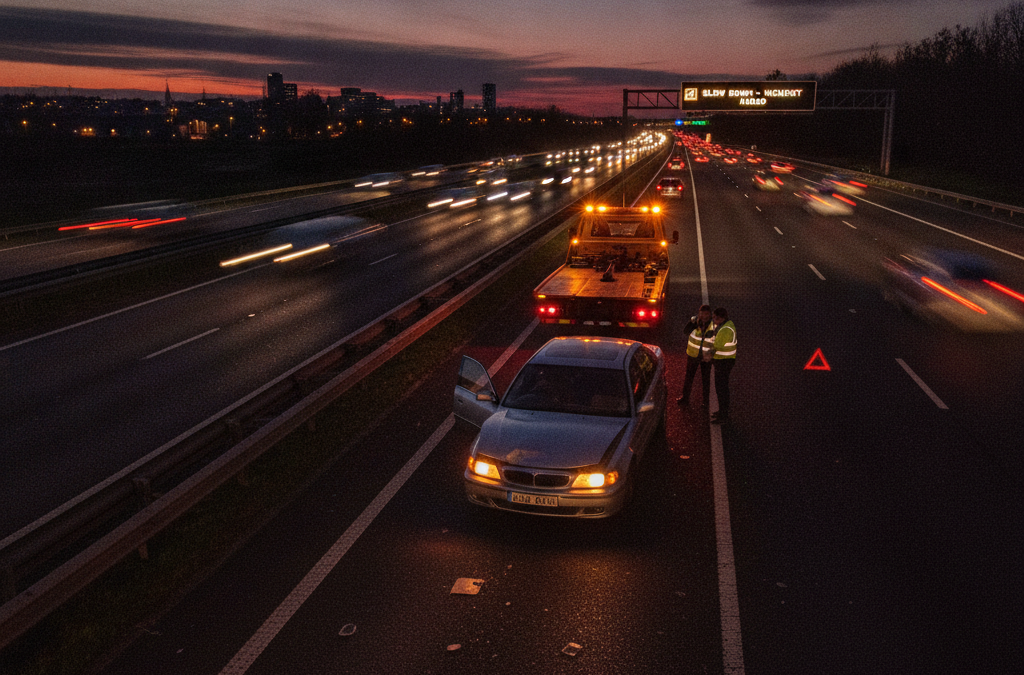
A breakdown on the M50 can feel stressful very quickly. Traffic is fast, lanes are busy, junctions come up quickly, and there is often very little time to think. Whether your car has lost power, a warning light has appeared, you have a puncture, or the engine temperature is climbing, the most important thing is to stay calm and focus on safety first.
The M50 is one of Ireland’s busiest roads, connecting large parts of Dublin and carrying commuters, delivery vehicles, buses, commercial traffic, and long-distance drivers every day. A small mechanical fault that might be manageable on a quiet local road can become dangerous on a motorway if you stop in the wrong place or try to fix it beside fast-moving traffic.
This guide explains what to do if your car breaks down on the M50, step by step. It covers how to get to safety, when to stay in the vehicle, what information to give a tow truck operator, and how to decide whether you need towing or roadside help. If you drive the M50 regularly, it is worth saving this advice now so you are not trying to make decisions under pressure later.
First Rule: Safety Comes Before the Car
When a car breaks down, many drivers instinctively worry about the vehicle first. They think about the cost of repairs, the inconvenience, or whether the issue can be fixed quickly. On the M50, that order of priority has to change. Your safety, your passengers’ safety, and the safety of other road users comes before the car.
If your car is still moving, do not make any sudden lane changes. Avoid braking sharply unless absolutely necessary. Indicate early, move left when it is safe, and aim for the hard shoulder, an emergency area, a slip road, or another safe place away from live traffic. If you cannot leave the carriageway, turn on your hazard lights immediately and call for help.
Never attempt roadside repairs in a live motorway lane. Even simple jobs such as changing a tyre, topping up coolant, or checking under the bonnet can be extremely dangerous when heavy traffic is passing at speed. The M50 is not the place to diagnose a problem while standing beside the vehicle.
Step 1: Recognise the Warning Signs Early
Many breakdowns give you a few seconds or minutes of warning. Noticing those signs early can make the difference between reaching a safer stopping point and being stranded in a dangerous location.
Common signs your car may be about to fail
- A sudden loss of power or poor acceleration
- Engine temperature gauge rising quickly
- Battery warning light or oil pressure warning light
- Steering becoming heavy or difficult
- Strong burning smell, smoke, or steam
- Unusual knocking, grinding, or rattling noises
- Tyre vibration, pulling to one side, or a loud bang
- Clutch slipping, gearbox issues, or failure to select gears
If any of these happen while driving on the M50, start planning your exit immediately. Do not wait to see if the problem goes away. A car that is losing power may stop completely within a short distance, and you may not get a second chance to reach a safer place.
For example, if you notice the temperature gauge climbing near Junction 9 or Junction 10, do not continue driving in the hope of reaching your final destination. Heat-related engine damage can become expensive very quickly, and stopping early may prevent further damage. More importantly, stopping safely before the vehicle fails completely gives you more control over the situation.
Step 2: Move Left and Stop as Safely as Possible
If the car is still driveable, check your mirrors, signal left, and move towards the left-hand side of the motorway. Keep your movements smooth and predictable. Other drivers may not realise you are having a problem, so avoid sudden swerves or hard braking unless there is an immediate hazard.
Where possible, leave the motorway at the next exit. A slip road, service area, retail park, garage forecourt, or side road is usually safer than the hard shoulder. If you cannot reach an exit, pull onto the hard shoulder as far left as you can. Try to stop with the wheels turned slightly left, away from traffic. This reduces the chance of the car rolling back into the carriageway if it is hit or moves unexpectedly.
Once stopped, switch on your hazard warning lights. In poor visibility, heavy rain, fog, or at night, use sidelights as well. Do not rely on other drivers noticing you in time; make your vehicle as visible as possible.
Step 3: Get Out Only If It Is Safe
On many motorway breakdowns, the safest place is not always inside the car. However, getting out can also be dangerous if you are beside live traffic. You need to judge the situation carefully.
If your car is on the hard shoulder and there is a safe barrier or verge, passengers should usually leave the vehicle by the left-hand doors, away from traffic. Move behind the barrier if one is available, and stand well back from the vehicle. Keep children, older passengers, and pets under close control. Do not stand behind or in front of the car on the hard shoulder.
If you have stopped in a live lane or it is not safe to exit, keep your seatbelt on, switch on hazards, and call emergency assistance immediately. Do not walk along the motorway. Do not cross lanes. Do not try to push the vehicle. Your goal is to make the situation visible and get professional help moving as quickly as possible.
The Road Safety Authority provides general road safety information for Irish drivers, and it is worth being familiar with official guidance before you ever need it. You can visit the RSA website for broader road safety resources.
Step 4: Call for Breakdown Recovery or Roadside Assistance
Once people are safe, call for help. When speaking to a recovery service, clear information helps them find you faster and send the right vehicle. On the M50, location details are especially important because saying “I’m on the M50” is not enough.
Information to give when you call
- Your direction of travel, such as northbound or southbound
- The nearest junction number or exit name
- Any nearby signs, gantries, bridges, or landmarks
- Whether you are on the hard shoulder, slip road, or in a live lane
- Your vehicle make, model, colour, and registration
- How many passengers are with you
- The symptoms of the breakdown, such as puncture, no start, overheating, or accident damage
- Whether you need towing to a garage, home address, or another destination
If you are not sure whether you need a tow truck or a mobile mechanic, it helps to understand the difference. A mobile mechanic may be suitable for some minor faults in a safe location, while towing is usually the better option if the vehicle is unsafe, immobile, badly damaged, overheating, or stuck on a motorway. TowNow has a helpful guide on tow truck vs mobile mechanic in Dublin that explains the difference in more detail.
Step 5: Do Not Try to Fix the Car on the M50
It can be tempting to attempt a quick fix, especially if you think the problem is simple. Maybe you have a spare wheel in the boot. Maybe you have jump leads. Maybe the bonnet release is right there and you want to check the coolant level. On the M50, this is rarely worth the risk.
Changing a tyre on the hard shoulder is particularly dangerous. You may need to kneel beside the car, use a jack on an uneven surface, remove wheel nuts, and position yourself close to passing traffic. A recovery operator has warning equipment, experience, and the correct procedure for dealing with roadside hazards. Even then, many vehicles are recovered to a safer location before work begins.
The same applies to overheating. Removing a coolant cap from a hot engine can cause scalding. Driving “just another few minutes” with an overheating engine can destroy the head gasket or cause major engine damage. If the engine is hot, stop safely, switch it off, and wait for professional advice.
If the car has an electrical fault, smoke, or a burning smell, keep well back. Do not keep trying to restart the vehicle repeatedly. Tell the recovery operator exactly what happened so they can approach the car safely.
What If You Break Down in Heavy Rain, Fog, or Darkness?
Bad weather makes an M50 breakdown more serious. Visibility is reduced, stopping distances are longer, and drivers may be more distracted by spray, glare, or poor lane markings. If rain, fog, or darkness is involved, treat the situation as higher risk.
Use hazard lights and sidelights, move away from the vehicle if it is safe to do so, and stand behind a barrier where possible. Do not use the boot as a shelter if it places you close to traffic. If you have high-visibility clothing in the car, wear it, but do not delay getting to a safe position just to search for it.
Weather conditions can change quickly around Dublin, especially during winter commuting hours. For forecasts and weather warnings, the Met Éireann website is a useful resource before longer journeys.
What If You Have a Puncture on the M50?
A puncture or blowout on the M50 can be frightening, particularly at motorway speed. If you feel the car pulling sharply, hear a bang, or notice heavy vibration, keep a firm grip on the steering wheel. Avoid slamming on the brakes. Ease off the accelerator, allow the car to slow gradually, indicate left, and move to a safe stopping point.
Once stopped, do not attempt to change the wheel beside live traffic. Even if your car has a spare, the hard shoulder is not a safe workshop. Call for roadside recovery and explain that you have a puncture. Depending on the location and the condition of the tyre, the vehicle may be moved to a safer place before any tyre work is carried out.
If the tyre has shredded, if the wheel rim is damaged, or if the car has been driven for a distance on a flat tyre, it may need towing rather than a quick roadside tyre change. Mention any visible damage when you call so the operator can prepare properly.
What If the Car Loses Power but Still Drives?
A car that loses power on the M50 is a serious concern even if it is still moving. You may be dealing with a fuel delivery fault, turbo issue, engine management problem, clutch fault, blocked filter, overheating issue, or electrical problem. The car may continue for a short time and then stop without warning.
If you can leave the motorway safely, do so. Take the next exit rather than trying to complete your journey. Once off the M50, stop somewhere safe and call for advice. If the car is struggling to maintain speed, do not remain in a middle or right-hand lane. Move left carefully and prioritise getting out of the traffic flow.
Continuing to drive a failing vehicle can turn a recoverable problem into a much larger repair. It can also leave you stranded in a worse place, such as between junctions or near merging traffic. If in doubt, stop safely and arrange assistance.
What If Your Car Will Not Restart After Stopping?
Sometimes a vehicle cuts out or stops after pulling over and then refuses to restart. This can happen because of a flat battery, alternator failure, starter motor problem, fuel issue, immobiliser fault, overheating, or a more serious engine fault. On a normal street, a jump start or quick inspection might be possible. On the M50, the location changes the decision.
If the car is on the hard shoulder, treat it as a recovery situation first. A tow truck can move the vehicle to a safer area where further checks can be made. If you are unsure whether the issue is suitable for roadside repair, read TowNow’s comparison of when to call a tow truck instead of a mobile mechanic. As a simple rule, if the vehicle is on the M50 and cannot move under its own power, recovery is usually the safest next step.
How to Help the Tow Truck Find You Faster
One of the biggest delays in motorway recovery is unclear location information. The M50 is long, busy, and complex, with multiple junctions, slip roads, lane merges, and nearby roads. Giving accurate details can reduce confusion and speed up the response.
Use your phone location carefully
If it is safe, use your phone’s map app to identify your approximate location. Look for the nearest junction number and direction. You can share a live location if the recovery provider supports it. However, do not stand in a dangerous place trying to get a better signal or a more accurate pin. Safety comes first.
Check signs and junction numbers
Motorway signs, gantries, and exit markers are helpful. If you passed a junction recently, say which one and whether it was before or after your current position. For example: “I am southbound on the M50, just after Junction 6, on the hard shoulder.” That is much more useful than “near Blanchardstown” or “somewhere on the M50.”
Describe your vehicle clearly
Give the colour, make, model, and registration. If you have hazard lights on, mention that too. If there are several vehicles stopped nearby, a clear description helps the tow truck identify you quickly and safely.
Should You Call a Tow Truck or a Mobile Mechanic?
The right choice depends on the fault and the location. On the M50, safety often makes the decision for you. If the vehicle is in a dangerous position, cannot be driven, has accident damage, has a serious warning light, or is overheating, towing is usually the safest option. A mobile mechanic is more suitable when the vehicle is already parked in a safe location, such as your driveway, workplace car park, or a quiet side road.
For example, a flat battery in your driveway may be a mobile mechanic or jump-start situation. A flat battery on the hard shoulder of the M50 is different because the vehicle and passengers are exposed to motorway traffic. In that case, the priority is moving the vehicle safely. For a fuller breakdown of the decision, see TowNow’s guide: Tow Truck vs Mobile Mechanic: Which One Do You Need?
What to Keep in Your Car for M50 Breakdowns
You cannot prevent every breakdown, but you can make one easier to manage. Keeping a few basic items in the car can help you stay visible, communicate clearly, and wait more comfortably while assistance is on the way.
- A fully charged phone or in-car charger
- High-visibility vest or jacket
- Warning triangle for suitable roads, though you should not place one in a dangerous motorway position
- Torch or headlamp
- Warm jacket or blanket during winter
- Bottled water
- Basic first aid kit
- Your insurance and breakdown assistance details
- Locking wheel nut key, if your wheels require one
Remember that equipment is only useful if it can be accessed safely. Do not stand at the rear of the vehicle rummaging through the boot if traffic is passing close by. If you need to leave the car quickly, leave non-essential items behind.
How to Reduce the Risk of Breaking Down on the M50
Some breakdowns happen without warning, but many are linked to maintenance issues. If you use the M50 regularly for commuting, airport runs, school journeys, or business travel, small checks can reduce your chances of being stuck at the roadside.
Check tyres regularly
Tyres are one of the most important safety items on your car. Check pressure, tread depth, and visible damage. Underinflated tyres can overheat and fail, while worn tyres reduce grip in wet weather. If you notice vibration at speed, have it checked before using the motorway again.
Do not ignore warning lights
A dashboard light is not just an inconvenience. Oil pressure, battery, brake, coolant temperature, and engine management warnings should be taken seriously. Some require you to stop immediately. If a warning appears before you join the M50, do not assume it will be fine until you get home.
Keep fuel or charge levels sensible
Running out of fuel or battery charge on the M50 is avoidable and dangerous. Keep enough range for delays, diversions, and unexpected congestion. Electric vehicle drivers should plan charging stops before range becomes critical, especially in cold weather when range can drop.
Service the car on schedule
Regular servicing helps identify worn belts, weak batteries, fluid leaks, brake issues, and cooling system problems before they become roadside emergencies. If your car is overdue a service and you regularly drive at motorway speeds, booking maintenance is a sensible investment.
Practical Scenario: Breakdown Between Junctions
Imagine you are travelling southbound on the M50 during the evening commute. The engine management light comes on, the car loses power, and you cannot maintain speed. You check mirrors, indicate left, and move carefully onto the hard shoulder. You stop as far left as possible, switch on hazards, and ask passengers to exit from the left side when safe. Everyone moves behind the barrier.
When you call recovery, you explain: “I am southbound on the M50, after Junction 7 and before Junction 9, on the hard shoulder. It is a silver Volkswagen Golf, registration number visible, hazards on, two passengers, loss of power and engine warning light.” That information is clear, practical, and useful. It tells the operator where you are, what they are looking for, how serious the fault may be, and whether passengers are involved.
This is exactly the kind of calm, structured response that makes a breakdown safer. You are not trying to repair the car. You are not standing beside traffic. You are not continuing to drive a failing vehicle. You have made yourself visible, moved people away from danger, and given recovery the information needed to respond.
Conclusion: Stay Calm, Get Safe, Call for Help
If your car breaks down on the M50, the key steps are simple: recognise the problem early, move left safely, stop away from traffic if possible, use hazard lights, get passengers to a safe place when it is safe to do so, and call for professional help. Do not attempt repairs beside motorway traffic, and do not continue driving a vehicle that may be unsafe.
The M50 is a high-speed, high-volume road, so a breakdown needs to be handled differently from a local street or car park. A quick fix is not worth risking your safety. If you are unsure whether the car can be repaired where it is, assume recovery is the safer option and let a professional assess the situation in a controlled way.
By preparing in advance, knowing what details to give, and acting calmly, you can reduce risk and get the right assistance faster. TowNow is here to help drivers across Dublin when breakdowns happen, including stressful situations on and around the M50.